
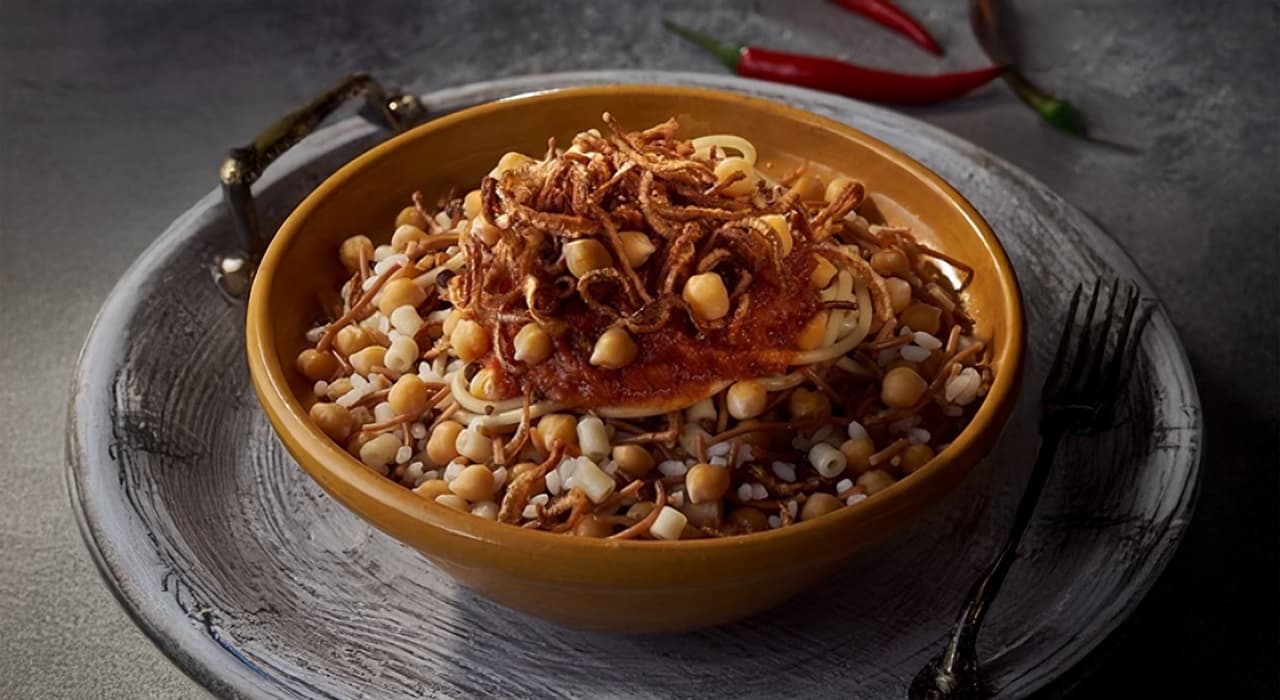
Koshary
By:Eng/ Samira Abdelkader
Koshary is an Egyptian dish that stretches back thousands of years. It began as a mixture of wheat and brown lentils, in fact, pottery containing cooked lentils mixed with wheat and barley was discovered in tombs at Draa Abu el Naga in Thebes. These artifacts are currently preserved in the Ancient Agriculture department of the Agricultural Museum.

Religious texts also mention a recipe called Koshir made from wheat and lentils. In the Middle Ages, after rice cultivation was introduced to Egypt, rice and sometimes Rishta noodle like dough replaced the wheat. Many travelers who visited Egypt throughout history wrote about this rice and lentil mixture. The medieval cookbook Kanz al Fawaid contains several recipes for mixing rice with chickpeas and other legumes. Once tomatoes were introduced to Egypt, the dish continued to evolve over the years into the version we recognize today.

It is incorrect to claim that the dish Ibn Battuta saw in India is the origin of Egyptian Koshary. They are entirely different; the Indian version is cooked with a type of legume called Mung or Mash,which is completely unknown in Egypt. On the contrary, several recipes actually traveled from Egypt to India during the Mamluk era such as Zalabia, Sambousek, and various bread recipes due to the movement of soldiers and Egypt’s role as a central trade hub between India and Europe.

It is also a misconception that Egyptians only learned of Koshary during the British occupation. Travelers like Richard Burton, Charles Didier, and Bayram V mentioned finding Koshary in Egypt well before the British arrived. Even the ancient Greeks, upon arriving in Alexandria, famously remarked, Alexandria is a city filled with lentils. They noted that the locals mixed lentils with various other legumes, including Phoenician varieties.

Enjoyed this article?
Discover more insights and stories from our blog. Stay updated with the latest trends in digital innovation.