
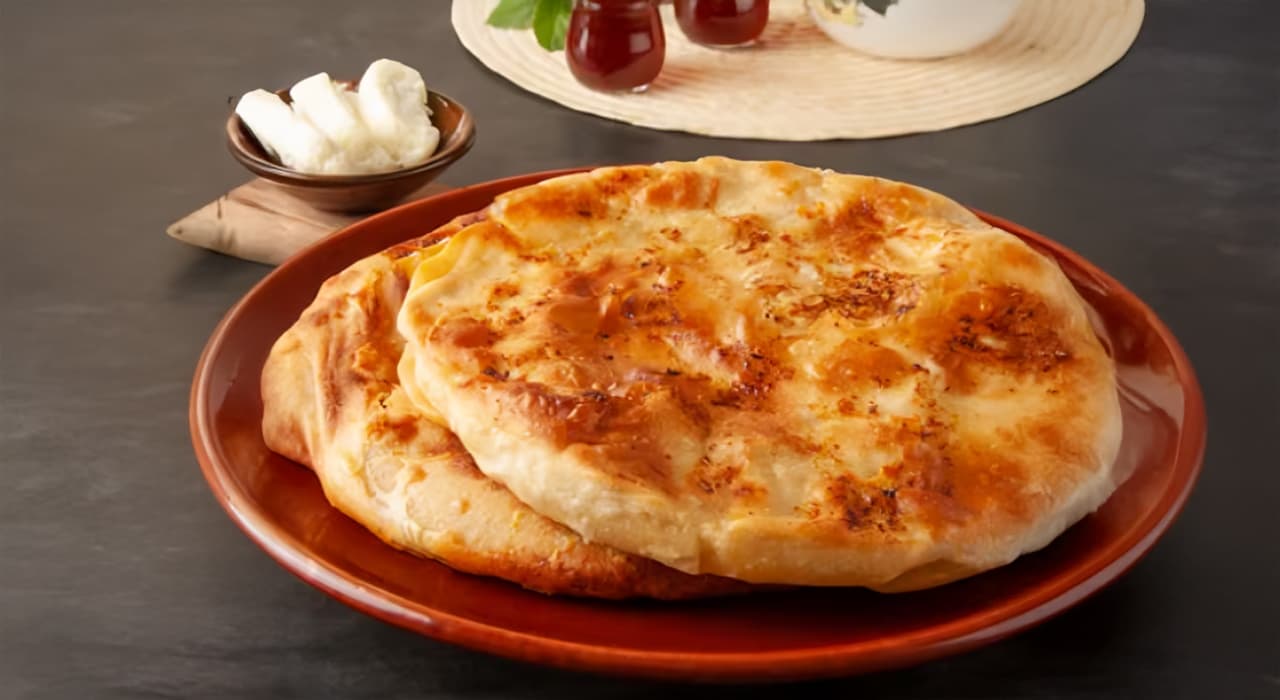
Feteer
By:Eng/ Samira Abdelkader
As previously mentioned, a type of pastry was discovered in the tomb of King Ramses III that is identical to the Feteer Meshaltet still eaten in Egypt today. This proves that Egyptians were the first to create layered pastries, contrary to the common claim that the Greeks invented them; in reality, the Greeks adopted the idea from the Egyptians.

Feteer Meshaltet was formerly known as Feteer Maltoot. It involves various preparation methods and shapes, including versions made with corn flour known as Feteer Muraddad.As seen in the tomb of Ramses III, the pastry is sometimes coiled into a spiral before being flattened and baked. Other times, it is folded like an envelope, with multiple layers tucked inside one another before the final flattening. The traditional method for Meshaltet requires one kilogram of white flour, about two and a half cups of water, and half a teaspoon of salt. The most critical step is thorough kneading to develop the gluten until the dough becomes elastic. The dough is then left to rest for several hours or overnight. It is divided into three balls, each rolled out until completely transparent, then coiled and left to rest again. Finally, it is pressed down and baked in a very hot oven for about fifteen minutes, then covered immediately upon removal to keep it soft.

Feteer Muraddad is a richer version of Meshaltet. While it follows a similar technique, the dough is kneaded with curdled milk known in Egypt as Laban Rayeb and brushed with a layer of farmer’s cream Qishta before baking. In some villages, Muraddad is made with multiple layers like Meshaltet, while in others, it is prepared as a single layer similar to flatbread.

Unlike the Maltoot varieties which are unleavened, other types of Egyptian pastries use yeast, such as Feteer Damasi. Several variations stem from this, made with either corn or white flour, sometimes shaped into small discs known as Qurs Tariya. The recipe for Damasi includes one kilogram of flour, a quarter kilogram of cream, a quarter kilogram of butter, a tablespoon of yeast, a tablespoon of sugar, and enough curdled milk to bind the dough. All ingredients except half the cream are kneaded together and left to rise for about an hour. The dough is then divided into equal balls, flattened, topped with the remaining cream, and baked at a high temperature for only five minutes. It is worth noting that these Egyptian pastries, including Damasi and Muraddad, were explicitly documented in texts dating back to the Ottoman era, specifically in the 17th century.

Reference:


Enjoyed this article?
Discover more insights and stories from our blog. Stay updated with the latest trends in digital innovation.