
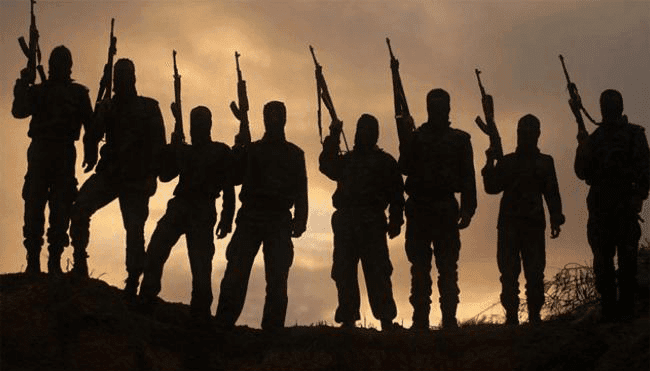
Egyptian cinema in the face of terrorism and extremism
Egyptian cinema was and still is communicating with members of society by presenting thorny issues that concern all groups, and Egyptian filmmakers were keen to address issues of terrorism and extremism in many films that included terrorist attacks, bombings, assassinations, and attempts to attract young people in various ways. Egyptian cinema paid attention early to the attempts of extremist groups to gain power. The first embodiment of this thought was in 1979, through a single scene in the movie “Alexandria Why” in which the character of Hassan Al-Banna appeared in a meeting with a group of officers planning a coup against the government, where he touched on To the issue of the religious state and the preachers who dream of a caliphate.
However, for many years, cinema preferred not to approach this thorny issue for fear of exaggerating it, considering terrorism only as an individual phenomenon, and over time, this phenomenon was depicted superficially without addressing the details of terrorist groups or the ideas they embrace. Until terrorism began to clearly increase in Egypt, and cinema entered the stage of in-depth presentation of extremist thought and its causes, and from that time until the present day, many films have appeared that dealt with terrorism in one way or another, criticized this phenomenon and called for fighting and confronting it. In this article, we review together a group of cinematic works that presented the phenomenon of terrorism and extremist ideology from different angles.
Terrorism 1989
The film's events revolve around Esmat (Nadia El-Gendy), head of the accidents department at Akhbar Al-Youm newspaper, who is covering a terrorist operation that targeted a minister. Omar Al-Sanadili (Farouk Al-Fishawy), who was able to deceive Esmat and convince her of his innocence, is accused. She sympathizes with him and becomes attached to him, and challenges everyone to publish a press investigation in which she defends Omar.
Esmat is preparing to travel to Abu Dhabi to attend an international conference on crime. Omar asks her to send a gift to a relative of his there, but she discovers that the box contains dynamite to blow up the plane on which a delegation of ministers is traveling to attend the conference. Esmat quickly informs the police and cooperates with them to catch Omar and the judiciary. on him.
Terrorism and Kebabs 1992
The terrorist's appearance in this film was purely coincidental, as he is a victim of injustice and oppressive circumstances that placed him in a situation of holding hostages at gunpoint in exchange for the government implementing his requests. The events of the film took place inside the Tahrir Complex, where Ahmed (Adel Imam) goes to transfer his two children from one school to another. Due to administrative obstacles, he clashes with security, seizes the weapon of one of the soldiers, and unintentionally opens fire. The employees think that terrorists have taken control of the complex. Ahmed finds himself involved in taking some hostages, and a group of citizens join to help him. Soon the police surround the place, and negotiations begin with the Minister of the Interior, who is determined to storm the building if the terrorists do not surrender and release the hostages.
Ahmed decides to leave the hostages, but they sympathize with him, especially after they realized that his demands for fair, humane treatment represent the same demands as theirs, and they refuse to leave without him so that he will not be arrested, and they are determined to have him leave among them as if he were one of the hostages, so the police forces storm the compound and do not find any terrorists.
Terrorist 1994
The film discussed the story of a poor young man named Ali Abdel Zaher (Adel Imam), whose social circumstances prompted him to join a terrorist group. Ali participates in an assassination operation, and while escaping, he is hit by a car driven by Sawsan Abdel Moneim (Sherine), who takes him to her home so that her father, Dr. Abdel Moneim Hassanein (Salah Zulfiqar), can treat him. For fear of police intervention, the family preferred to treat him at home, and Ali agreed so that his matter would not be revealed. Feelings of love grow between Sawsan and Ali, especially after her family treated him well. During this, he discovers that he has been deceived by the terrorist group, which kills him as a penalty for his defection from them, especially after he tried to alert one of the figures that the group intends to assassinate.
Birds of Darkness 1995
The film tells the story of three lawyer friends. The first is Fathi Nofal (Adel Imam), a committed person who turns into an opportunist who wants to reach the highest positions, and exploits his capabilities to become the director of a minister’s office. The second is Ali Al-Zanati (Riyad Al-Khouli), who wants to achieve material gains, so he joins an extremist terrorist group, and becomes entrusted with defending the group’s members and arousing public opinion by filing cases against the state, in an attempt to control the reins of government. He also tries to recruit Fathi to join the group. The third, Mohsen (Ahmed Ratib), is a downtrodden employee who decides to stay away from the ongoing conflict between the government and extremist groups.
Fathi hires Samira, the night girl (Yousra), to help him in his business activities, which he used as a cover for his suspicious activities, but she is arrested and confesses to Fathi, who is imprisoned under investigation, while Ali Al-Zanati participates in planning terrorist operations, so he is arrested and put in prison, and there the two friends meet. The confrontation and conflict between them continues.
Destiny 1997
The film presented the phenomenon of extremism and terrorism in a historical context, as it goes back in time to the twelfth century AD in Andalusia, specifically during the rule of the Caliph Abu Jaafar Al-Mansur (Mahmoud Hamida), and tells the struggle of the philosopher Ibn Rushd (Nour Al-Sharif) with the political authority of the Caliph, whom he was a friend of. Then he began to harbor feelings of hostility towards the extremist religious groups that succeeded in recruiting the Caliph's youngest son (Hani Salama) into their ranks. This is the conflict that ended with Ibn Rushd being declared an infidel and his books being burned twice, the first at the hands of the terrorist group, and the second when the Caliph became angry with him and ordered him to be exiled from the country.
The other 1999
The film shed light on the alliance between extremist groups and capitalist entities to serve their common interests, through the love story that brought together journalist Hanan (Hanan Turk) and Adam (Hani Salama), a young Egyptian man who holds American citizenship and is conducting a study on the phenomenon of religious terrorism. The two lovers insist on getting married despite the refusal of Adam’s father, the Egyptian businessman Khalil Amara (Mahmoud Hamida), and his arrogant American mother, Margaret (Nabila Obaid).
Enjoyed this article?
Discover more insights and stories from our blog. Stay updated with the latest trends in digital innovation.