
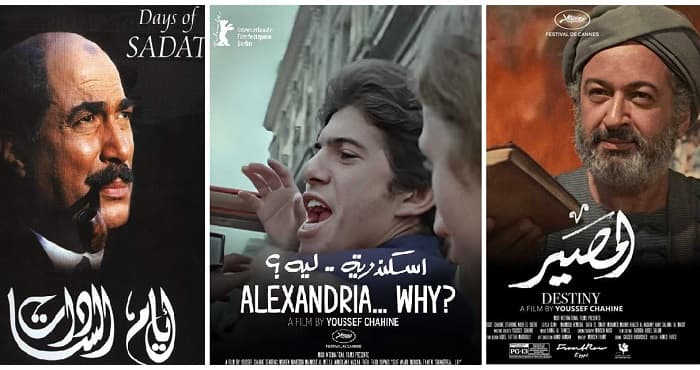
Ahmed Zaki and Youssef Shaheen are the most prominent ones who presented it.. Why were biographical films absent from Egyptian cinema?
There are many cinematic styles presented by filmmakers in Egypt. We find spectacle, comedy, historical, and romantic films. Even horror and fantasy, Egyptian cinema has not neglected to present them in its films.
But a good observer of cinema in Egypt will notice that there is an artistic style that has been subjected to injustice and neglect, and has been absent from cinema in our country, which is biographical films.
Despite our long history, which is full of important and influential figures who can be presented in hundreds of films, to honor them for their achievements and contributions to society and the country in various fields, and so that their memories remain immortal and preserved in the minds of viewers, most producers have refrained from presenting this type of film because of... Being a thorny field they may easily fail and expose themselves to loss. This is due to several reasons, including, for example, the families of these characters, who may still impose restrictions on production, and are keen to play the role of watchdog and judge of work events. It is also due to production reasons, as these types of films may require filming in places where filming is not permitted except after obtaining security permits. In addition, the profits of these films may not cover their high production costs, because they are not very popular among the Egyptian audience.
However, there are some artistic experiments that broke this rule and dealt with the biography of a group of prominent and influential figures, and in the following article we review with you a group of the most important of these cinematic experiments.
Abu Zaid Al-Hilali 1947
The film tells the story of the knight “Abu Zaid al-Hilali,” the prince of Bani Hilal and the commander of the Arab armies. His story begins when his mother, “Khadra al-Sharifa,” saw a strong crow and wished to God to grant her a child with his strength, even if he was the same color as him. Her wish came true and Abu Zaid Al-Hilali came with black skin, which made his father, “Rizq Al-Hilali,” accuse his wife of treason and expel her from the tribe, so she took refuge in the Bani Zahlan tribe. “Abu Zaid” grows up to become a commanding knight, and a war breaks out between the tribes of Bani Hilal and Bani Zahlan, and “Abu Zaid” fights his father, “Rizk,” which makes the mother confess his true lineage to her son. When the two confront each other on the battlefield, Rizk feels something towards Abu Zaid, so he recognizes him as his son and restores his respect to his mother, whom he accused of honoring her. “Abu Zaid” returns to the “Bani Hilal” tribe and fights in their ranks.
Khalid bin Al-Walid 1958
The film reviewed the life story of the companion Khaled bin Al-Walid, whom the Messenger nicknamed the drawn sword of God. The film deals with his journey since he was a polytheist and fought the Islamic call, until he was the reason for the defeat of the Muslims in the Battle of Uhud. Until God granted him to convert to Islam after the Treaty of Hudaybiyyah, where he became one of the strongest and most intelligent leaders of the Islamic armies. Khalid bin Al-Walid was known for his participation in the wars of apostasy, as he fought apostates from Islam, the most famous of whom was “Musaylimah the Liar,” who claimed prophethood. The film also touched on participation in fighting the Persians and Romans, defeating them, and the conquest of Iraq and the Levant.
Beautiful 1958
The film chronicles the story of the struggle of the Algerian girl, Jamila Bou Harid, who joined the Algerian Liberation Front to fight against French colonialism when she was twenty years old. “Jamila” participates in many commando operations, until she is arrested after being shot in the shoulder. “Jamila” is tortured by Colonel “Bijar” until she confesses the names of the guerrillas and their hiding places, but she courageously endures all types of torture and refuses to betray her country. One of the guerrillas manages to smuggle documents condemning the torture of “Jamila” and sends them to Egypt to broadcast them so that the world learns about “Jamila’s” case, forcing the French to hold a mock trial and sentence her to death. But after the United Nations Human Rights Committee met, after it received millions of denunciatory telegrams from all over the world, the sentence was commuted to life imprisonment, and after Algeria’s independence in 1962, “Djamila” came out of prison and assumed the presidency of the Algerian Women’s Union.
Antar bin Shaddad 1961
The film dealt with the life story of the brave knight and pre-Islamic poet, “Antar bin Shaddad,” who was fathered by “Shaddad,” the prince of Banu Abs, from his slave girl, “Zubaida,” and refused to acknowledge him, so he became a slave serving his father. “Antar” falls in love with “Abla,” his cousin, who refuses to marry his daughter to a black slave, and tries to impede him by requesting a large dowry of 1,000 of “King Al-Numan’s” camels. “Antar” travels to a distant country until he obtains “Abla’s” dowry, after facing hardships and horrors. He returns years later to find his beloved almost marrying his rival. The two struggle, and Antar wins and marries Abla.
Shafiqa Al-Qibtiya, 1962
The film tells the life story of Shafiqa Al-Qibtiya, the most famous Egyptian dancer in the nineteenth century. She was famous for dancing in front of the elite, including pashas, ministers, and senior statesmen. Shafiqa is forced to leave her child, Aziz, in her mother’s care after her father disowned her, expelled her from the house, and forbade her from seeing her son. Aziz grew up and fell in love with Souad, the daughter of Asaad Fahmi Pasha, the Prime Minister who was Shafiqa’s lover. When Aziz proposed to marry his lover, her father rejected him, insulted him, and expelled him from his home. “Shafiqa” wanted to take revenge for her son, so she exposed “Asaad” in front of his wife and insulted him, so he punished her by issuing an order to arrest her son. Shafiqa resorted to alcohol and drugs, lost her money gambling, and sold her palace, when she received news of her son’s death in detention as a result of torture. However, he was alive and managed to escape from the prison and returned to his grandmother’s house to find “Shafiqa,” who found no one to turn to after her condition deteriorated except her mother. “Shafiqa” died in the arms of her son, who finally learned from his grandmother that “Shafiqa” was his mother.
Al-Nasir Saladin 1963
The film presented the life story of the leader “Salah al-Din al-Ayyubi,” who succeeded in uniting the ranks of the Arab armies to liberate Jerusalem from the Crusader occupation, in what was historically known as the Battle of Hattin. Despite the signing of a peace treaty, Renaud de Chatillon, the leader of the Crusader army, attacked and slaughtered the pilgrims going to Mecca, so Saladin decided to take revenge on him, defeat him and take him prisoner. So his wife begins, “In
Enjoyed this article?
Discover more insights and stories from our blog. Stay updated with the latest trends in digital innovation.